

Editorial review: 8 October 2026. The comparison of A/B and multivariate testing has been clarified to reflect uncertainty and avoid guaranteed-result claims. The original publication date is retained.
A/B Test
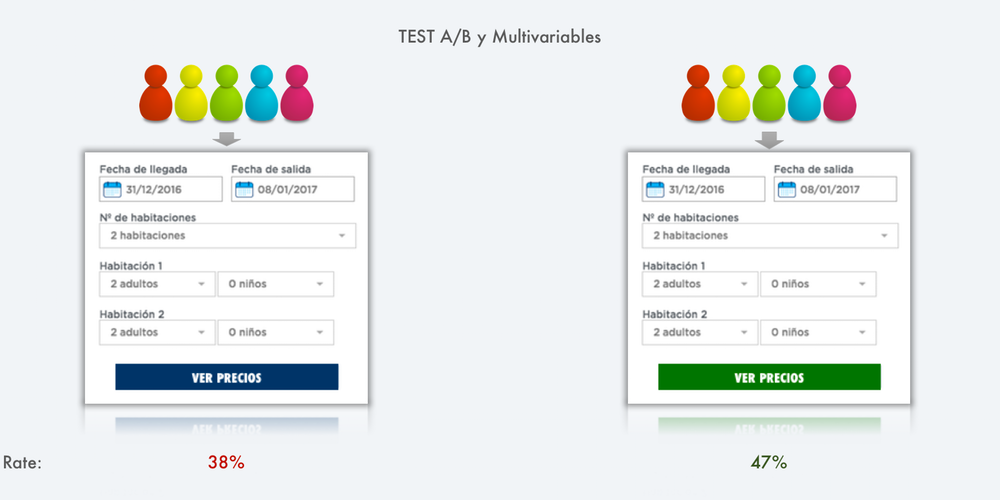
An A/B test is carried out to optimize a website. Two versions are compared: the control, which retains the current experience, and a variant containing the proposed change. The variant may change one element or a complete design, according to the hypothesis; a test of a complete design does not isolate the contribution of each changed element. A 50/50 traffic split is common, but allocation should be defined as part of the experiment rather than treated as a universal requirement. Before launching, define the main metric, allocation, duration and analysis criteria. After collecting sufficient data for the planned analysis, compare the results and their uncertainty. A test can provide evidence about conversion; it cannot establish absolute certainty, and a conversion-rate difference does not by itself measure profit.
Multivariate Test
A multivariate test evaluates combinations of multiple elements using a defined experimental design. It is more than simply launching several alternative pages: the design determines which effects and interactions can be estimated. Depending on the experimental design, this type of test can help assess individual elements and interactions between them. The combinations tested and the available sample determine what can be concluded. Unlike the A/B Test, the Multivariate Test requires more time and traffic to obtain results, since it is necessary for a greater number of users to pass through the test so that the results are statistically relevant and can be taken as reliable.
Conclusion
Ongoing experimentation can help improve the booking journey, but not every test produces a winning change. Record inconclusive and negative results as well, and evaluate completed bookings and commercial value alongside conversion rates.
For current applications to hotel websites, see our analysis of AI, direct bookings and experimentation for 2027.