Editorial review: 8 October 2026. This article retains its 2021 post-pandemic context. Unsourced performance percentages and unconditional profitability claims have been corrected. The original publication date is retained.
Despite the sea of unknowns in which the hotel sector has been submerged since the beginning of the pandemic, during this year and a half, we have seen how direct sales were for many hotels the main source of income and a true pillar, even in the worst moments of crisis. The increase in direct bookings during the pandemic is due to many factors, including:
-
- The guest’s need to feel safe, a need that has led to greater interaction between the guest and the accommodation staff.
- The opportunity for hotels to provide first-hand, property-specific information and personalised service during an uncertain period.
- The closure of many physical travel agencies.
- The stagnation of tour operators.
- Innovations and improvements in conditions by Google, including Google’s “Free Booking Links” (service launched on March 9, 2021, complementary to the Google Hotel Ads program).
- The development of new technological tools aimed at enhancing the hotel’s direct channel and increasing direct bookings (such as chatbots, booking engines with artificial intelligence, loyalty platforms, etc.).
The direct channel can support a strong guest relationship and a healthy margin. Its profitability should nevertheless be assessed after acquisition, technology, payment and servicing costs, alongside cancellations and the value of each booking.
Therefore, at Hotel’s Performance we consider, now more than ever, that investing in the direct channel should be a priority in any hotel’s post-pandemic recovery plan. We are going to tell you how to get the most out of it and increase direct bookings. Today we start with the website:
Prepare your showcase: your website is your shop window
A website is the most powerful tool for any business, but nowadays it is not enough to have an attractive design. The website has to offer an excellent user experience, since it is your most important communication channel. We know that having a good website is a challenge, but what is the use of having a fantastic room if your clients cannot see it as it is, fantastic?
Images – First impressions count—or rather, the first visit to your site counts— because if it is not impressive from the beginning, there will be no second chances and everything will have ended in a single visit. The images have to be the mirror of your hotel and reflect its beauty, so only high-quality, high-resolution images should be used.
It’s not always summer and it’s not always winter either! If your hotel is seasonal, invest in updating the images on a seasonal basis and always bear in mind that the content (texts) must adequately accompany the images.
Content – Make your guests dream before arriving at the hotel! Another important aspect is to write attractive and useful texts for the user and at the same time write for SEO using keywords that help position your site in search engines.
Languages – Address your target audience in their language, invest in quality content personalized for each language.
Usability – In addition to being attractive, a site has to be functional so we should never focus only on one aspect or another, both are very important. Help the user find all the important information in a simple and intuitive way and make the booking engine always visible.
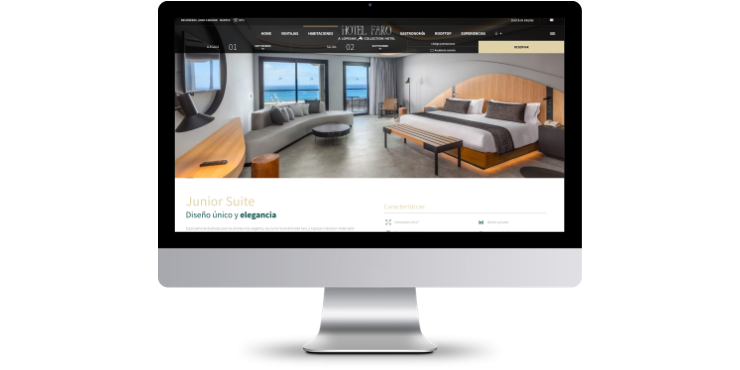
We sell rooms! – Lately we have seen an error that has become, let’s say, quite common and that is that many hotel web pages lack information about the rooms or the rooms have a position that is not adequate on the site. The user must be able to access information about the rooms in a single click and from the Home page. Services or facilities such as the spa, entertainment, restaurant, pool or gym should never take priority over the rooms or make them harder to find. And of course, just mentioning the name of the rooms, their prices, the m² and whether or not they have views is not enough, we sell rooms that we want our guests to dream of.
Speed – One of the most important aspects is the loading speed of your site. Users are already used to websites loading fast and this is precisely the experience that must be provided. Measure performance with real-user data and investigate slow loading, poor responsiveness and layout shifts. There is no single loading-time figure that guarantees conversion or a top search position. Google Search Central: page experience. To optimize the loading speed of the site, we recommend optimizing images, avoiding excessive multimedia content, using a server with the resources your site needs and ensuring good coding practices.
Booking engine – We know that choosing a suitable booking engine is a complex decision, so we recommend paying maximum attention to this aspect, as it has a significant impact on the profitability of a hotel / chain. There are hundreds of booking engines on the market and in order to make the right decision, at Hotel’s Performance we believe that it is best to do an analysis of the specific needs of your establishment and assess the functionalities of various booking engines.
Define clear and real benefits for booking directly on your website
A welcome detail can add value, but a direct-booking benefit should be relevant to the guest and genuinely distinguish the offer. Avoid presenting standard inclusions available on every channel as exclusive advantages. A best-price claim must be accurate and supported by clear conditions; installing a price comparator is not, in itself, proof of that claim. Compare flexibility, inclusions and payment terms as well as price, and explain each benefit consistently on the website and in the booking engine. Here are some suggestions:

Optimization according to the device – Another “must” is to optimize the design of our website according to the different devices. Review the hotel’s own traffic and booking data by device. Responsive design and testing on real phones, tablets and desktops help identify barriers without assuming a universal device share.
Know your audience – Knowing your audience will help you target them in an appropriate way and thus increase your conversion rate. Having more information about your audience will allow you to create an optimal site that correctly communicates the values of your brand and satisfies the needs of your potential clients.
Analyze and test – Let us remember that we never know everything and can always improve. To do so, we need to carry out continuous analysis and testing, draw relevant conclusions and implement improvements. At Hotel’s Performance we recommend the implementation of advanced measurement tools and the performance of A/B and multivariate tests both on the site and in the booking engine to achieve our goal, which is to transform the largest number of users into customers.
Working on these aspects can reveal opportunities to improve direct-channel conversion. Validate changes against the hotel’s own results rather than assuming that every redesign will increase bookings. Of course, apart from the improvements to be implemented on the website and its optimization there are many other equally important aspects such as the use of cutting-edge technology, the generation of quality traffic to your site, the implementation of loyalty strategies, etc. which we will talk about in future articles.