


How independent hotels and small and medium-sized groups can prepare to compete in late 2026 and throughout 2027: a convincing website, experiments that improve conversion, and connections that enable bookings through AI.
Conceptual image created with AI for Hotels Performance. It does not depict a real property or team.
Analysis by Hotels Performance. Information checked on 8 October 2026. The outlook for 2027 presents reasoned scenarios, not guaranteed results.
Artificial intelligence is changing how travellers discover hotels, compare alternatives and move towards a booking. For independent properties and small and medium-sized hotel groups, the opportunity is to turn that change into more profitable direct bookings, while maintaining a straightforward booking experience and their own relationship with the guest.
As 2026 draws to a close, traditional search engines, AI-generated answers, online travel agencies, social recommendations and conversational assistants already coexist. During 2027, it is reasonable to expect closer connections between these experiences and booking systems, although their reach will depend on the country, provider and available integrations.
The strategy needs to bring together three elements: a hotel website that builds trust and converts, well-designed A/B and multivariate tests, and infrastructure ready to sell when the purchase journey begins with AI.
Booking through AI: what is possible and what to prepare
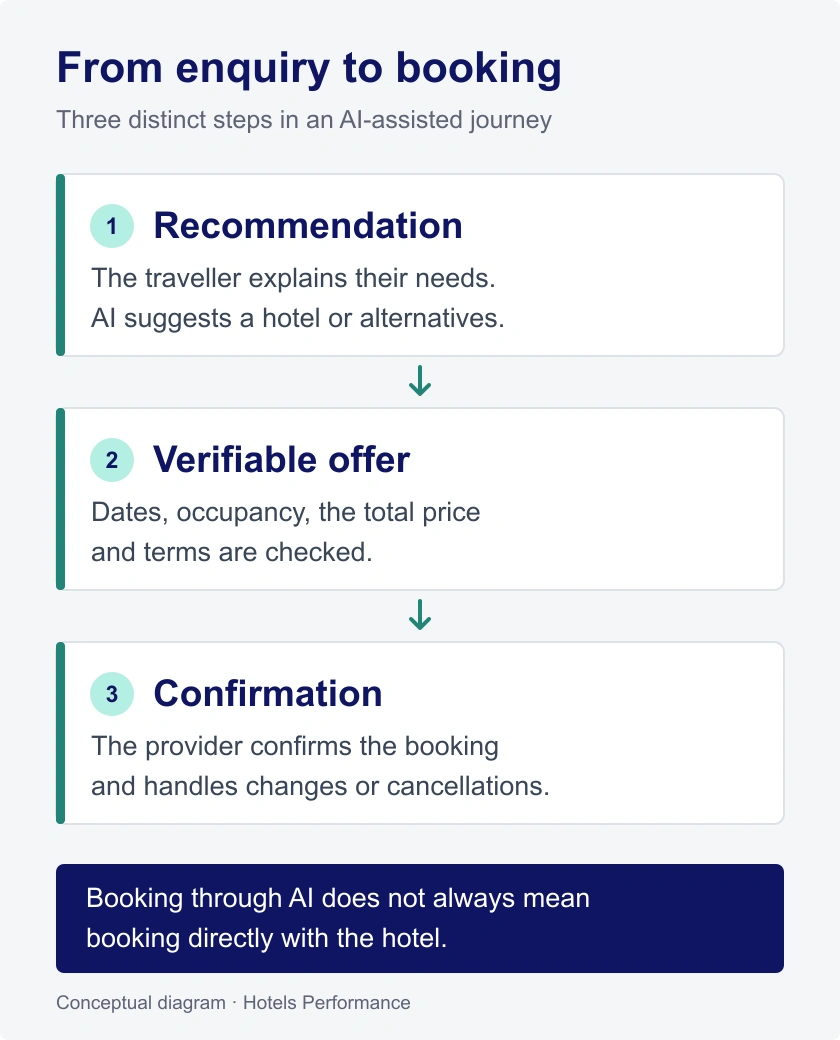
It is useful to distinguish between three situations. An assistant can recommend a hotel; it can direct a user to an offer on a website or an OTA; or it can facilitate the transaction within its own experience, connected to a booking provider. Each journey has different implications for direct sales and attribution.
On 27 August 2026, Google announced new features for booking hotels through AI Mode. Its documentation limits this option to the United States, English, and selected properties and providers. It is a tangible sign of change, but it does not mean that any Spanish hotel can already sell through this route. Google’s announcement and current availability conditions.
When assessing an integration, a hotel needs to establish who confirms the booking, takes payment, handles changes and cancellations, receives guest data and charges any commission. A conversation taking place in an AI interface does not automatically make the transaction a direct booking. The channel needs to be defined by its commercial relationship and effective cost.
Preparation starts by asking the booking engine and channel manager which connections they actually offer, in which markets, and on what terms. A demonstration should check availability, occupancy, children’s ages, taxes, restrictions, policies, payment and confirmation. An experience that looks good but loses these details can cause problems and erode margins.

Your hotel website becomes more important as a source of trust and a conversion channel
A traveller may discover a hotel in a conversation and then visit its website to check rooms, location or terms. They may also reach the booking engine through a deep link. The homepage, room pages, offers and direct entry points into the purchase process therefore all need to work well.
The website provides space to explain what makes the property distinctive: room layouts, family facilities, specific accessibility features, opening hours, parking, experiences and the benefits of booking directly. This information should be original, verifiable and consistent with the booking engine, local business listings and external channels.
Google retains the fundamentals of SEO in its guidance for generative search: useful content, a clear structure and a technical foundation that allows it to be discovered. There is no guarantee of appearing in an AI answer. For hotels, our recommendation is to answer the questions that influence a booking accurately and keep those answers up to date. Google’s official guide to generative search.
An assistant can summarise a commercial offer; it will struggle to communicate a service that the hotel itself describes ambiguously. Information quality is part of the distribution strategy.
Remove barriers to booking before attracting more visitors
The first conversion task is to review the entire journey: landing page, dates, occupancy, room selection, rate, extras, personal details and payment. Every transition should retain the context and make the decision easier, particularly on mobile.
Among the opportunities we recommend reviewing are total price clarity, cancellation information, room comparisons, form errors and consistency of language and currency. It is also worth checking speed, accessibility, readability and how easily a guest can return to a search.
The benefits of booking directly must be real and understandable. A welcome gift, greater flexibility or an included service can add value when its conditions are clear. A generic “best price” promise needs supporting evidence; a benefit that disappears on entering the booking engine creates distrust.
AI can help classify customer questions, review content and identify potential friction. The assessment should be completed with user observation, accessibility checks and tests of the actual process. An automated analysis of a screenshot does not demonstrate that a website converts better.
How to use AI to improve experimentation
AI is particularly useful for connecting scattered signals: questions to reception, booking enquiries, internal searches, booking engine issues and guest comments. Working with appropriate data and without exposing unnecessary personal information, it can help identify patterns and prioritise opportunities.
The next step is to turn those patterns into specific hypotheses. For example: “If we explain cancellation terms alongside the price, we will reduce uncertainty and increase confirmed bookings among visitors comparing rates.”
From there, AI can prepare alternative copy, translate it for review, propose designs, assist with implementation and identify errors before launch. Afterwards, it can summarise results and suggest new questions. The final decision must rest on the experiment’s design and data, with professional review.
AI-simulated traveller profiles are useful for exploring questions; they do not replace real guests or demonstrate a conversion uplift. Nor should every generated variant be published automatically: an inaccurate commercial promise can cost more than any improvement achieved.
A/B testing: finding out what really improves direct bookings
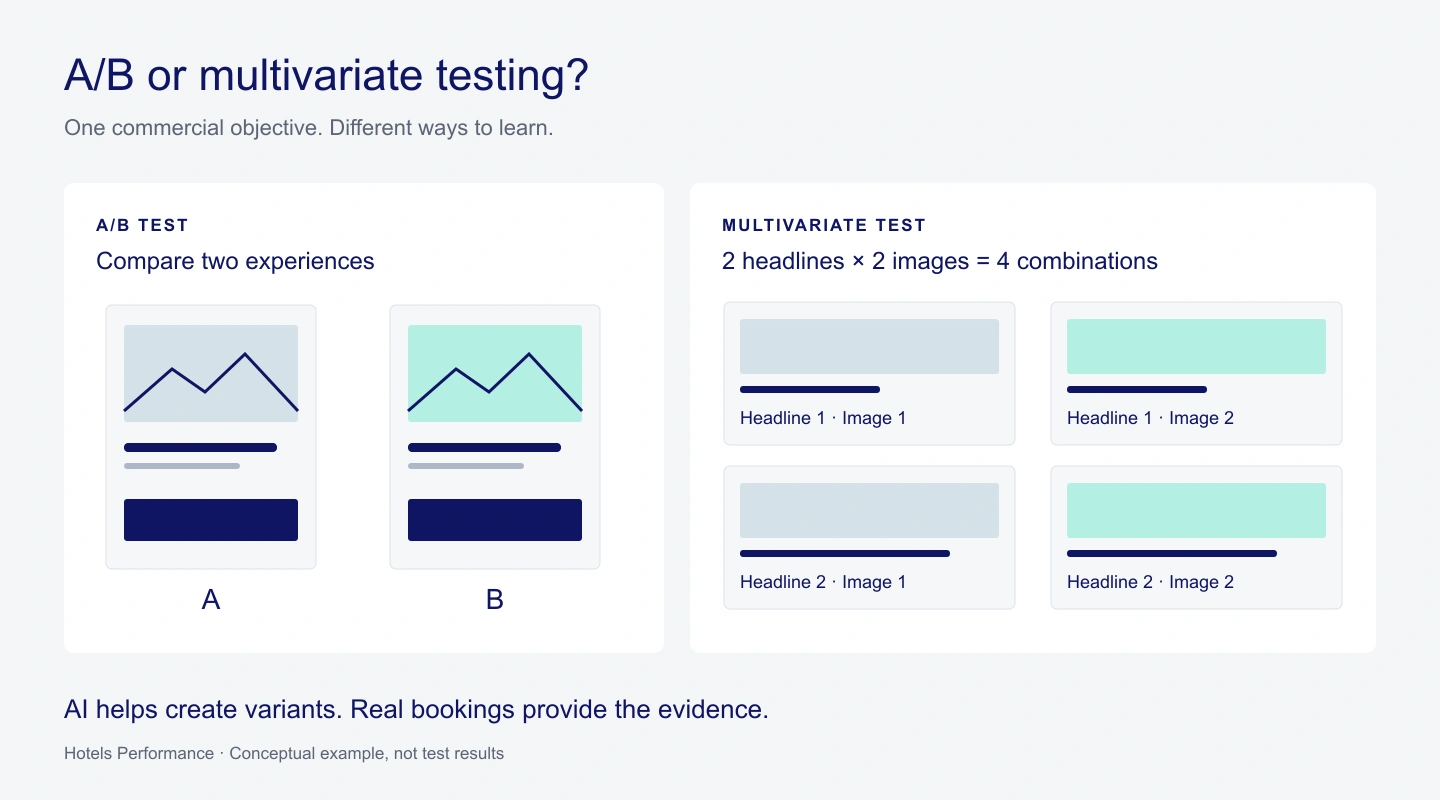
An A/B test compares two experiences by assigning users randomly and consistently. The current version serves as the reference, while the alternative tests a hypothesis. It is preferable to compare both over the same period, avoiding confusion between the change itself and seasonality, campaigns or events in the destination.
Before starting, define the primary metric, the smallest effect that would be commercially worthwhile, the required sample and the analysis rules. Allocation and measurement also need to be checked. These principles form part of Microsoft Research’s recommendations for trustworthy experimentation.
For a hotel, valuable hypotheses might include:
- Explaining direct booking benefits next to the availability search.
- Comparing rooms through differences that matter to the guest.
- Making the conditions of a flexible rate clearer.
- Simplifying occupancy selection on mobile.
- Preserving dates and occupancy when moving from an offer to the booking engine.
A test can change an entire experience, although the result will then relate to the whole change and will not attribute the effect to individual elements. Choose a scope that answers a specific commercial question and that the team can maintain if it works.
Multivariate testing: learning about combinations without spreading traffic too thinly
Multivariate tests study several elements and their combinations. In a full factorial design, two headlines, two images and two benefit messages create eight combinations. The aim may be to understand both the effect of each factor and the interactions between them.
AI makes it easier to produce consistent variants and review their quality, but having more alternatives does not provide evidence in itself. Dividing traffic and analysing several effects makes the design more demanding and generally requires a larger sample than a straightforward comparison.
For a hotel with few website bookings, we suggest starting with a high-impact A/B test and one main hypothesis. Once sufficient volume is available, a multivariate test can help refine a page or module. Its feasibility should be calculated before launch; there is no universal visitor threshold or fixed duration that works for everyone. Optimizely explains the sample requirements of multivariate testing.
Within a group, pooling hotels only makes sense if they share a comparable experience and the analysis accounts for their differences. Combining a city hotel and a resort without a sound basis can conceal different responses and produce a recommendation that is useful to neither.
Measure bookings, margin and trust
A click on “Book” signals intent. The final metric must follow the journey through to a valid confirmation, without counting the same transaction twice. If the website and booking engine use different domains, measurement continuity and attribution need to be reviewed with their providers. Google’s guidance on cross-domain measurement explains this continuity.
Alongside booking conversion rate, it is worth assessing revenue or contribution per user assigned to the experiment, acquisition cost, discounts, commissions, extras and cancellations. A variant may generate more initial bookings but less net business. Cancellations need a sufficient follow-up window; the immediate result should be identified as provisional.
Speed, payment errors, complaints and accessibility act as quality controls. Improving a figure at the expense of confusing the guest is not a sustainable improvement.
Avoid declaring a winning variant at the first favourable result or searching retrospectively for a segment that “looks good”. The method must account for duration, multiple comparisons and any sequential analysis. Microsoft Research documents common interpretation pitfalls that can lead to mistaken decisions.
Personalisation and assistants that help guests book
AI can adapt its help to needs expressed by the traveller: a room for two adults and two children, a late arrival or a stay with parking. Its value increases when it draws on verified information and can lead to a search with dates and occupancy already selected.
To answer questions about availability or prices, it needs to consult up-to-date systems. A model trained on hotel content does not know the current inventory by itself. If it cannot verify it, it should explain that and offer a reliable way to continue.
In a transactional process, the user must be able to review the total price, rate, cancellation terms and details before confirming. The architecture must also prevent duplicate bookings and make it clear whether the transaction has been completed. Handover to a person remains important when exceptions or questions arise.
Personalisation can be tested through experiments, retaining a control group. We suggest starting with relevance and clarity, without using artificial pressure, invented scarcity or differences in treatment that the hotel cannot justify.
Priorities for different sizes of hotel and group
Independent hotel: review measurement and the booking engine, resolve obvious friction and select a first experiment. AI can support a small team with research, content and analysis, using a limited set of tools and clear responsibilities.
Small hotel group: share components, learning and measurement criteria while preserving each property’s characteristics. A change tested at one hotel can generate a hypothesis for another, but should not be assumed to deliver the same result.
Medium-sized hotel group: establish a continuous experimentation programme, coordinate campaigns and tests, and assess integrations with new AI channels. Avoid several simultaneous changes affecting the same users and making results impossible to interpret.
In every case, tool selection should consider integration, support, speed, data export and total cost. The licence price is only part of the picture: implementation, maintenance, review and dependence on the supplier also matter.
A 90-day plan to prepare for 2027
Days 1–30: build a reliable foundation. Audit the booking journey, reconcile data with the booking engine, review content and terms, and collect the most frequent questions. Choose a primary metric and prioritise hypotheses by impact, evidence and effort.
Days 31–60: launch the first viable experiment. Prepare variants with AI assistance, review design and copy, check measurement and calculate the sample. If volume does not allow a conclusive test, prioritise user research and justified corrections, without presenting a before-and-after comparison as causal evidence.
Days 61–90: learn and decide. Analyse the available evidence, review quality indicators and document what has been learnt. Continue the test if it has not yet met its stopping conditions. In parallel, assess actual opportunities to connect with AI assistants through the booking engine.
The 90 days organise the work; they do not guarantee an improvement or require an experiment to end prematurely. An inconclusive result can also help avoid an investment based on false certainty.
Privacy, transparency and control as part of conversion
Trust requires explaining when an AI assistant is involved, making human assistance available and using data proportionate to the purpose. Before connecting analytics, personalisation or testing tools, the relevant processing and consent requirements need to be reviewed. Exemptions for certain audience measurements have specific conditions and should not automatically be extended to all experimentation. AEPD criteria for audience measurement.
The EU AI Act introduces transparency and training obligations that need to be assessed according to the use and the role of each provider. Its application is phased: it should not be assumed that all obligations begin in 2027. The European Commission’s official framework and timeline.
In practice, we recommend restricted access, action logs, response reviews and the ability to disable an integration. Payment data must remain within a secure process with a clearly defined scope.
What we expect from 2027 and how to prepare
Our outlook is for a greater role for assistants in search and comparison, more connections with transactional systems, and AI tools more closely integrated into optimisation work. The pace will vary. There is no basis for promising that all bookings will move through these channels or that OTAs will disappear.
Competition to become the traveller’s interface may also grow. Hotels therefore need to monitor new distribution opportunities alongside their costs, commercial terms and access to the data needed to serve guests and build loyalty.
The best preparation is a reliable website, a connected booking engine and a disciplined approach to improvement through experiments. This foundation benefits both guests who book directly and those who arrive through an AI recommendation.